


Essential regulations for fire protection systems in Peru: RNE, NFPA, ITSE, OSINERGMIN, and SNPCI
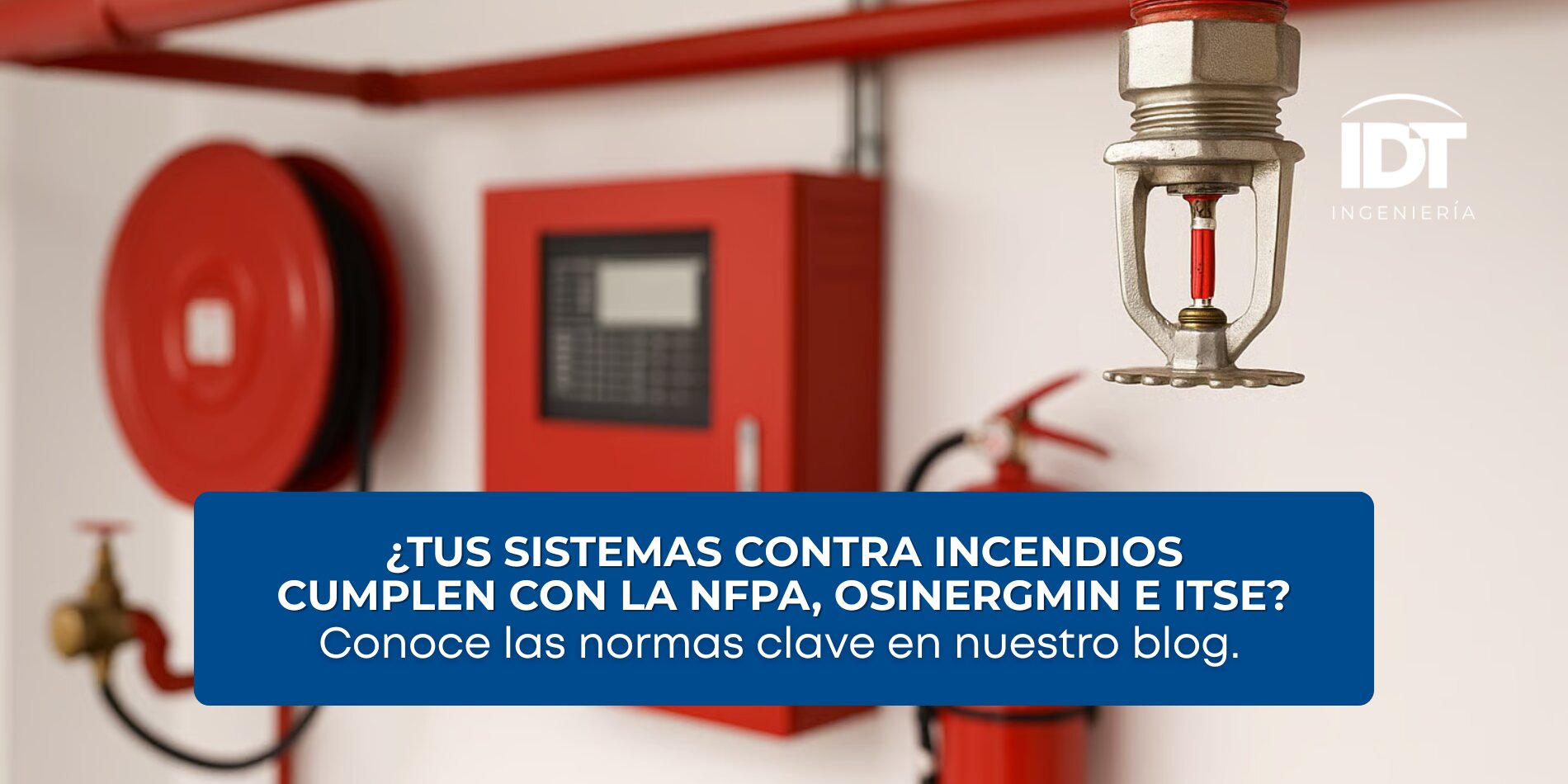
Investing in detection and suppression systems is not merely a legal obligation: it is the protection of lives, operational continuity, and asset preservation. This guide explains, in practical and actionable terms, what the regulatory framework in Peru requires (RNE and technical standards), which international references are commonly used (NFPA), how regulated sectors are affected (OSINERGMIN for mining and hydrocarbons), what ITSE is, and how SNPCI operates within the technical ecosystem.
1. National regulatory framework: RNE and applicable technical standards
The Reglamento Nacional de Edificaciones (RNE) is the mandatory technical regulation in Peru and includes provisions (e.g., G.050 and others) related to structural safety, evacuation routes, alarm systems, and minimum criteria for fire protection. All projects must justify their technical solution against the RNE within the technical dossier.
Commercial implication: Any contract with large companies must consider RNE compliance from the proposal stage to avoid rework and additional costs.
2. NFPA: international technical reference and its practical application in Peru
NFPA standards (for example, NFPA 13 — sprinklers; NFPA 72 — fire alarm systems; NFPA 10 — portable fire extinguishers) are widely used as technical references and best practices in Peruvian projects—particularly when local regulations require complementary technical criteria or when clients demand international standards. It is best practice to harmonize NFPA requirements with the RNE.
Technical recommendation: Specify in the technical dossier which edition of the NFPA was adopted and justify any local adaptations.
3. ITSE: what it is, validity and operational relevance
ITSE (Technical Safety Inspection of Buildings) is the certificate issued by municipalities or competent authorities to attest to building safety conditions. In many municipalities, the process and validity are explicitly regulated (in several cases validity is handled as a 2-year period, although municipal criteria and conditional validities exist). Keeping ITSE current facilitates operating permits and avoids municipal sanctions.
Operational note: Plan preventive maintenance and extinguisher refills / pump tests with ITSE renewal timelines in mind to ensure renewals without observations.
4. OSINERGMIN: requirements for mining and hydrocarbons
OSINERGMIN issues specific regulations for facilities in the mining and hydrocarbons sectors; its technical documents set design, installation, and maintenance requirements for fire protection systems and equipment (including requirements that certain maintenance and refills be performed by authorized workshops and referenced NTPs). Oversight in these sectors is rigorous and requires robust documentation.
Advice: For mining and oil & gas tenders, include the OSINERGMIN-required documentation plan in the proposal from the start.
5. SNPCI: industry role, advocacy and competitive advantage
The SNPCI (National Society for Fire Protection) brings together companies and professionals in the sector, participates in technical dissemination, training, and proposals for regulatory amendment. Active participation in SNPCI grants access to technical working groups and advance notice of regulatory changes — a competitive advantage for clients seeking future-proof solutions and long-term compliance.
Institutional note: IDT INGENIERÍA participates in technical working groups and, due to its leadership ties within the industry, is well positioned to offer solutions aligned with emerging regulatory changes.
6. Practical compliance checklist
Copy this checklist into your proposal or compliance package:
✓ Complete technical dossier: drawings, hydraulic calculations for sprinklers (if applicable), detection schematics and alarm logic.
✓ Clear technical references: specify applied NFPA standards and the edition used.
✓ ITSE and municipal permits: validate requirements and validity periods prior to commissioning.
✓ OSINERGMIN documentation (if applicable): risk studies, certificates and maintenance records for mining/hydrocarbons facilities.
✓ Recorded preventive maintenance: refill logs, pump tests, sprinkler testing and control panel verifications.
✓ Training and drills: documented plans for audits and operational mitigation.
7. Risks and sanctions
Non-compliance can result in fines, denial of operating permits, suspension of activities, or sector-specific sanctions (mining/hydrocarbons). Operational risks from inadequate systems can generate larger losses (plant damage, production downtime, and legal exposure).
8. Quick value proposition
What we offer (IDT INGENIERÍA): technical diagnosis + gap analysis (RNE / ITSE / NFPA / OSINERGMIN) → design and supply → installation and commissioning → scheduled maintenance and inspection support. Outcome: regulatory compliance, operational continuity, and reduced legal and operational risk.
Request a free technical pre-assessment to determine your compliance level and investment priorities.
FAQ
- What is ITSE and what is its validity?
ITSE is the Technical Safety Inspection of Buildings. In many municipalities, its validity is typically handled in periods such as two years, but it can vary depending on the municipality and the type of building. - Is NFPA mandatory in Peru?
NFPA standards are not always legally mandatory in Peru; however, they are widely accepted as technical references and are often required by clients, regulatory entities, and project supervisors. - What does OSINERGMIN require for fire protection systems in mining?
OSINERGMIN requires risk studies, documented compliance with technical requirements, and that certain maintenance activities be performed by authorized companies in accordance with applicable technical standards (NTPs).
References
Centro Nacional de Estimación, Prevención y Reducción del Riesgo de Desastres. (2023). Guías técnicas sobre inspecciones y seguridad en edificaciones. CENEPRED. Retrieved from https://www.cenepred.gob.pe/
Ministerio de Vivienda, Construcción y Saneamiento. (2022). Reglamento Nacional de Edificaciones (RNE). Ministerio de Vivienda, Construcción y Saneamiento del Perú. Retrieved from https://www.gob.pe/mvcs
Ministerio de Vivienda, Construcción y Saneamiento. (2022). Norma G.050 – Seguridad durante la construcción (RNE). Ministerio de Vivienda, Construcción y Saneamiento del Perú. Retrieved from https://www.gob.pe/mvcs
Gobierno del Perú. (2023). Procedimiento para obtener el Certificado de Inspección Técnica de Seguridad en Edificaciones (ITSE). Gobierno del Perú. Retrieved from https://www.gob.pe/
Organismo Supervisor de la Inversión en Energía y Minería. (2023). Reglamentos y disposiciones técnicas sobre sistemas contra incendios en minería e hidrocarburos. OSINERGMIN. Retrieved from https://www.osinergmin.gob.pe/
National Fire Protection Association. (2024). NFPA codes & standards. National Fire Protection Association. Retrieved from https://www.nfpa.org/
Sociedad Nacional de Protección Contra Incendios. (2024). Misión y actividades gremiales. Sociedad Nacional de Protección Contra Incendios. Retrieved from https://www.snpci.org/